Literature discovery · patent pending
Over 60% of scientific findings are backgrounded at publication.
Cnidarix finds backgrounded results in published papers and turns them into new hypotheses worth testing.
Every published paper tells a story. Its data hold more: findings in the figures and their captions, tables, supplementary data and secondary results that the main narrative leaves behind.
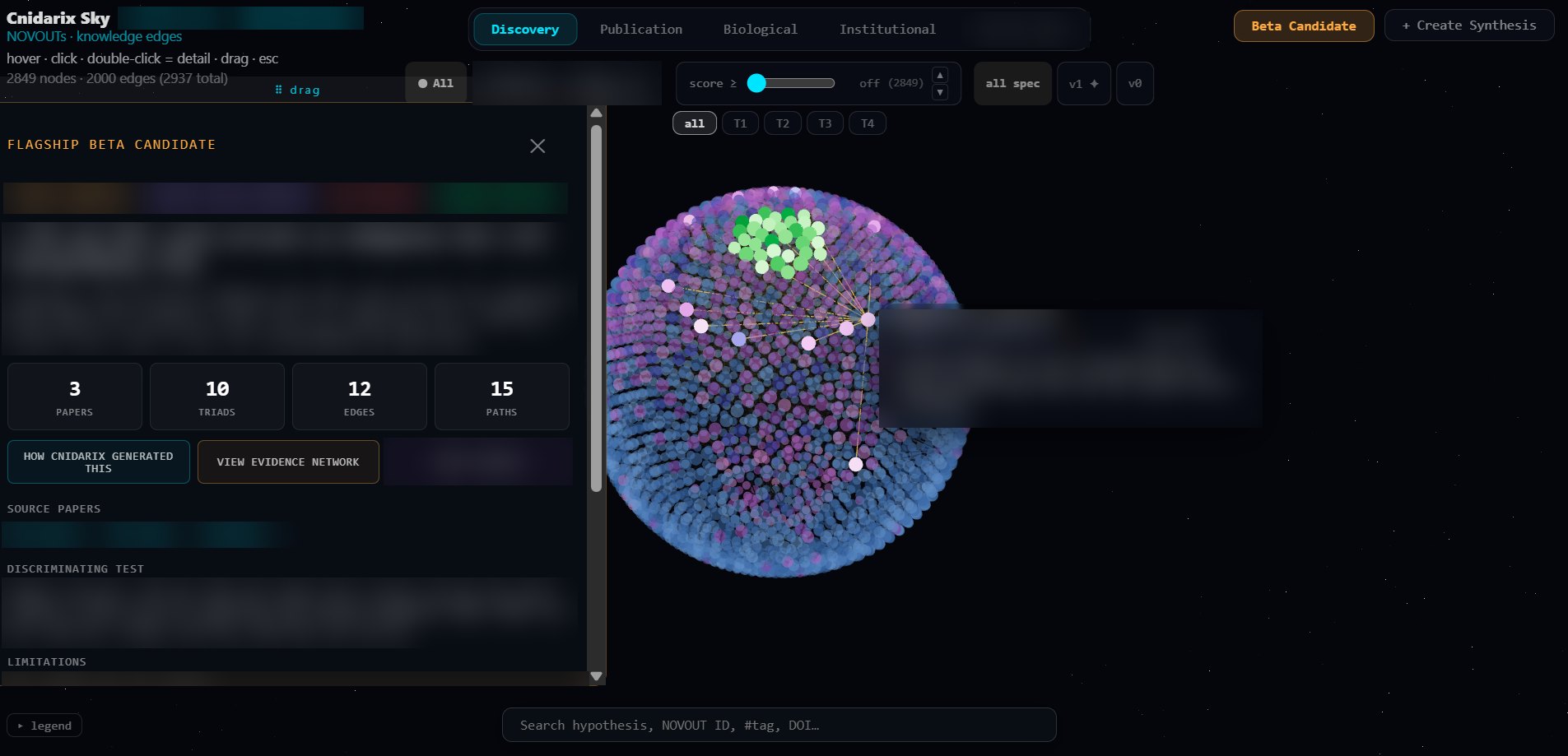
Cnidarix reads the literature at the level of all individual findings and connects them across papers into new, testable hypotheses. Each one is ranked by how strongly the literature supports it, and traces back to the exact published sentences it came from.
The result: evidence-backed new directions, before anyone commits lab time or money.
Approach
The overlooked majority.
Why findings get left behind
A paper is written around very few main claims. Those claims rest on a multitude of observations in the methods, figures, tables, supplementary material or a passing sentence, which remain backgrounded and outside the main narrative. Publication simply rewards one coherent story, and the rest is backgrounded.
What Cnidarix does with them
We treat each reported finding as a unit of evidence, separate from the story it appeared in. Backgrounded findings from the original papers are then connected across many papers to form new hypotheses: specific, testable statements, such as a regulatory link between two genes.
How we check our work
- Every hypothesis traces back to the exact published sentences behind it.
- We check what Cnidarix finds against what other scientists have already established independently.
- Every analysis can be repeated, and gives the same answer each time.
- We report what hasn't worked as well as what has.
Where it works best today
Molecular biomedicine: gene and protein relationships in areas such as neurodegeneration, hearing loss and regenerative medicine, metabolic disease, immunology and wound healing. We're extending it to other fields through partnerships.
About
Built by a working scientist.

Founder
Serban San-Marina founded Cnidarix after about 30 years in biomedical research, in academic and corporate settings. He held a Research Scientist appointment at Mayo Clinic, is a named inventor on US Patent 12,558,402, Jellyfish Collagen Use (issued February 2026), and has spent his career where data meets interpretation, including proteomics analysis for clinical biomaterials research.
- Training
- MD, PhD
- ORCID
- 0000-0002-5312-4774
- Publications
- Google Scholar
- Patent
- US 12,558,402
Why Cnidarix
Cnidarix began with a question of fairness: when a new discovery is built on someone else's overlooked data, the original authors should share in the credit. Answering it meant first finding that overlooked data systematically. That became the core of the platform.
Company
Cnidarix, Inc. is a Delaware corporation founded in March 2026. Contact: [email protected]
Beta access
Join the beta.
Cnidarix is in an invitation-only beta. Each tester gets a study built around their own field, and we ask only for an honest scientific opinion in return.
Already invited?
Sign in with your ORCID iD to open your study.
Invited testers receive their sign-in link by email.
What is Cnidarix?
A discovery system that finds results science published but never used, and turns them into new hypotheses worth testing. Patent pending.
Where do these overlooked results come from?
Every paper presents a few main claims, built on a large number of observations that support them, in the methods, figures, tables and supplementary material. An abstract tells a coherent story rather than listing every data point, so most of these observations stay in the background and are rarely followed up. Cnidarix brings them back into view and connects them across papers.
How do you know the results are trustworthy?
Every hypothesis traces back to the exact published sentences it came from, and our methods are tested against independent, curated biological databases.
Who is it for?
Researchers, institutions and companies looking for evidence-backed new directions in their field, before committing lab time or funding.
What does beta access involve?
You sign in with your ORCID iD and work through a study in your field. Access requires a short confidentiality agreement, since the beta includes unpublished work.
What beta testers see